Food and cooking thumbnails: what they have in common, and why
Food thumbnails are mostly about one thing: the finished dish, close enough to see its texture. Around it sit a sign that the food is hot and fresh, a background that makes it stand out, and a couple of words at most. This page explains why, walks through three made-up examples, and shows how each example title fits YouTube's title boxes as we measured them in November 2026.
Updated 2026-11-18
Make tools for creators? Sponsor this page.
What food and cooking thumbnails tend to share
The finished dish, very close
The dish fills most of the frame and is often cropped at the edges.
Why it is done: Appetite comes from texture: melted cheese, a glossy sauce, a soft yolk. Texture is the first thing lost when a picture shrinks. An up next thumbnail on a laptop is 235 pixels wide (our measurement, 16 November 2026), so only a dish that fills the frame keeps any.
A sign that it was just made
Steam, a cheese pull, noodles lifted on chopsticks, a sauce mid-pour.
Why it is done: A still plate can look like a stock photo. A little movement says somebody cooked this a moment ago, and it gives the eye one place to land.
Warm food on a background that is not warm
Golden and brown food over dark slate, a bright white kitchen, or a blurred room. Green herbs and red chilli as small accents.
Why it is done: Most cooked food lives in a narrow range of oranges, yellows and browns. If the background is in the same range, the dish melts into it. A dark or cool background is what gives the dish an edge.
Two words, usually the promise
A time, a place or a claim, set over the background and never over the food.
Why it is done: The dish is the hook. The words give the reason to pick this recipe over the next one: it is fast, it is cheap, it can be done at home.
A face is optional
Channels built around a host show the cook holding the dish. Channels built around the recipe show hands at most.
Why it is done: A face helps regular viewers recognise the channel. It also takes room from the food, so it only earns its place when the person is part of the reason to watch.
Three worked examples
Each one is drawn to show the conventions above. Look at what the picture does, then at what the words add.
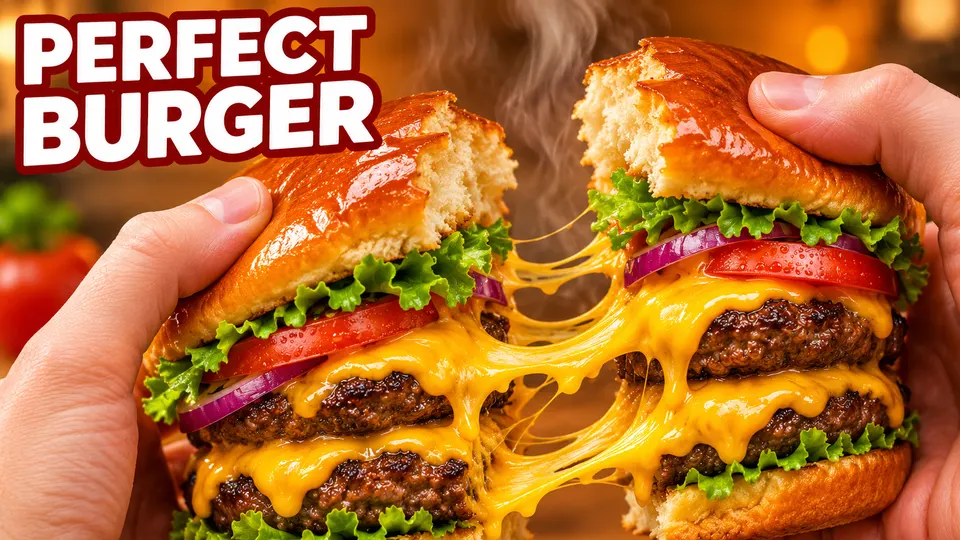
Made-up example, not a real video. How to Make the Perfect Burger
Two hands pull a burger apart and the cheese stretches between the halves, with steam rising in front of a blurred, warm kitchen. PERFECT BURGER is at the top left in white with a dark red edge. The cheese pull does the work here. The words are the weakest part, because they repeat the title instead of adding to it.
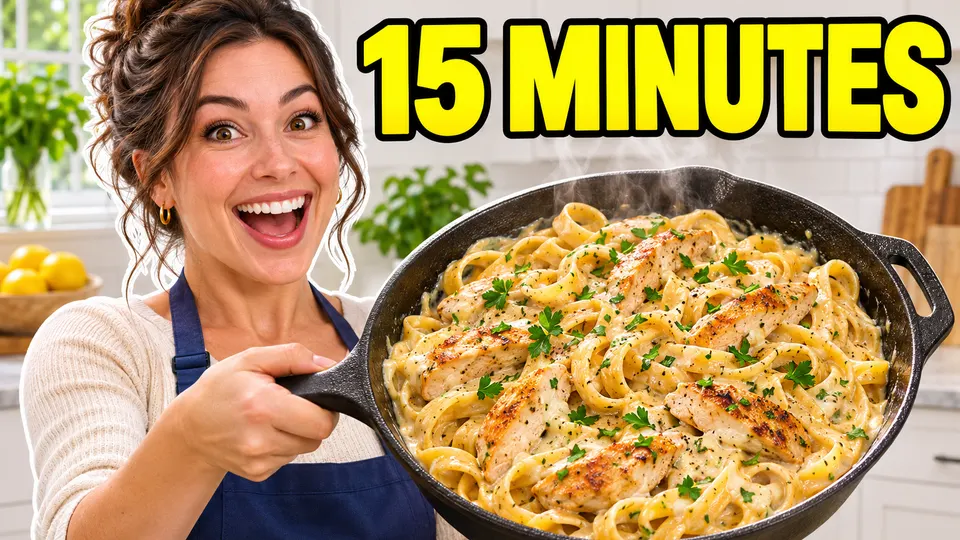
Made-up example, not a real video. 15-Minute Creamy Garlic Chicken Pasta
A smiling cook on the left holds a cast-iron pan of creamy pasta towards the camera, so the pan is the largest thing in the frame. 15 MINUTES runs across the top in yellow, and the kitchen behind is bright white. The words carry the promise, and the same promise opens the title.
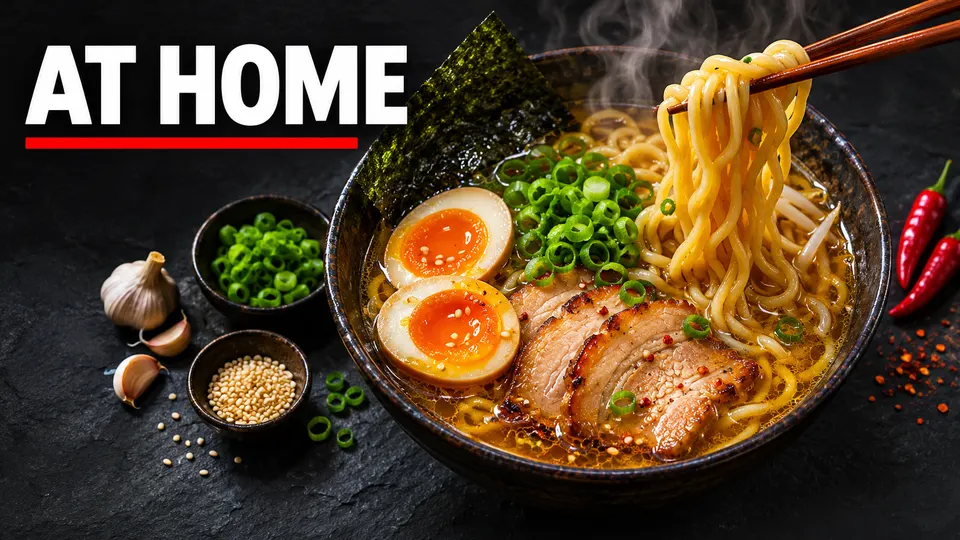
Made-up example, not a real video. Restaurant-Quality Ramen at Home
A bowl of ramen on dark slate: two soft egg halves, sliced pork, spring onion, and noodles lifted on chopsticks with steam above them. AT HOME is on the left in white with a red underline. There is no person. The dark background makes the yolks and the broth the brightest things in the picture, and the two words finish the title's thought.
Do the example titles fit?
We wrapped each example title into YouTube's title boxes with the same code our Title Checker uses. The box sizes were measured on youtube.com in November 2026, and this table was computed on 2026-11-17. All three are shown in full on every surface we measure. Short titles are the norm in the examples for a reason: the thumbnail carries the hook, so the title can stay brief.
| Title | Characters | Home feed, laptop | Home feed, large monitor | Search results, laptop | Up next sidebar, laptop | Phone feed, 390px wide |
|---|---|---|---|---|---|---|
| How to Make the Perfect Burger | 30 | Shown in full | Shown in full | Shown in full | Shown in full | Shown in full |
| 15-Minute Creamy Garlic Chicken Pasta | 37 | Shown in full | Shown in full | Shown in full | Shown in full | Shown in full |
| Restaurant-Quality Ramen at Home | 32 | Shown in full | Shown in full | Shown in full | Shown in full | Shown in full |
The narrowest box is the up next sidebar on a laptop: 129 pixels wide, three lines. The full method and numbers are in our guide to where YouTube cuts off titles.
When to break the pattern
- Baking and desserts often go bright and pastel instead of dark. Follow the food: pale food needs a darker or more colourful surround, dark food needs a lighter one.
- If the video is a test or a ranking (cheap against expensive, ten brands compared), it borrows from challenge videos instead: split frames, prices and faces.
- Some dishes do not look good finished. For a stew or anything brown, show the best moment of making it: the pour, the cut, the pull.
Check your own thumbnail
- Shrink it to sidebar size. Is the dish still recognisable, or is it a warm blur?
- Is there one clear focal point, such as the yolk or the cheese pull?
- Is all the text over the background, with none covering the food?
- Count the words on the image. More than three is usually the title leaking into the thumbnail.
See yours next to these three
The Thumbnail Preview opens with the food and cooking examples already in place. Add your thumbnail and title to see them in the home feed, search, up next and on a phone. Nothing is uploaded.