Commentary and video essay thumbnails: what they have in common, and why
Commentary and video essay thumbnails look serious on purpose: a muted, often abandoned scene, a host who looks doubtful rather than excited, red marks on the evidence, and a short phrase that opens a question. This page explains why, walks through three made-up examples, and shows how each example title fits YouTube's title boxes as we measured them in November 2026.
Updated 2026-11-19
Make tools for creators? Sponsor this page.
What commentary and video essay thumbnails tend to share
A muted, moody scene of the subject
The place or thing the essay is about, in desaturated greys, teals and browns, often empty, dark or decaying.
Why it is done: The colour sets the tone before a word is read: this is a long, considered story, not a quick laugh. It also sets up the next pattern, because in a grey frame anything red becomes the brightest thing.
Red marks on the evidence
A hand-drawn red circle, arrow, underline or falling line on the detail that matters.
Why it is done: Red is usually the only strong colour in the frame, so the eye goes straight to it. The marks say that the video will show you something specific, and as plain shapes they still read when an up next thumbnail is 235 pixels wide on a laptop (our measurement, 16 November 2026).
A host who judges
The narrator, cut out at one side, looking sceptical, stern or suspicious: a hand on the chin, crossed arms, a frown.
Why it is done: People choose an essay for the narrator's take on the story. The expression shows the attitude of that take. Shock would promise a different kind of video.
A short phrase that opens a question
Two or three words in plain, heavy capitals, often off-white rather than yellow, sometimes with a red underline.
Why it is done: The phrase creates the gap and the title names the subject. In all three examples below the phrase is the first words of the title. That is common in this niche, and it is a trade-off: the phrase gets read twice, but the space could have carried something the title does not say.
Props that look like evidence
A document, a chart, a news screen, or the place itself.
Why it is done: An essay promises research. A prop that looks like a source suggests the research before the viewer has seen any of it, and it can stand in for things that cannot be shown, like a secret.
Three worked examples
Each one is drawn to show the conventions above. Look at what the picture does, then at what the words add.
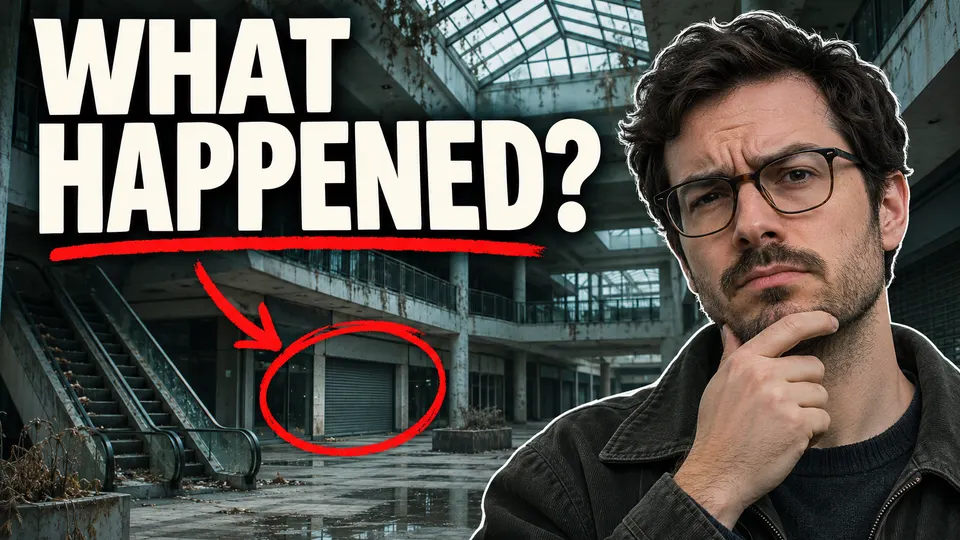
Made-up example, not a real video. What Happened to Every Shopping Mall?
An empty shopping mall under a glass roof: dead escalators, wet floors, and one shuttered shop ringed in red with a curved red arrow pointing at it. WHAT HAPPENED? fills the top left in off-white with a red underline, and the host stands on the right in glasses with a hand on his chin. The whole frame is grey-teal, so the circle is impossible to miss. The words are the opening of the title, so the thumbnail asks the question and the title finishes it.
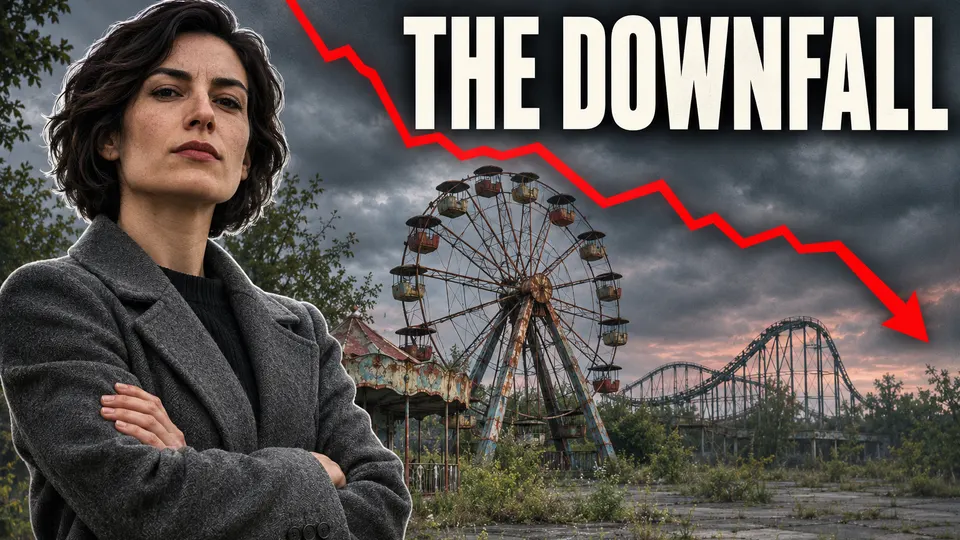
Made-up example, not a real video. The Downfall of a Billion-Dollar Theme Park
A rusted Ferris wheel and a roller coaster stand in overgrown ground under a stormy sky. A jagged red line falls across the frame from the top left to an arrowhead at the bottom right, like a share price crashing, and THE DOWNFALL sits top right in off-white. The host stands at the left in a grey coat with her arms crossed. The falling line does two jobs: it is the red mark, and it is the story's shape in one stroke.
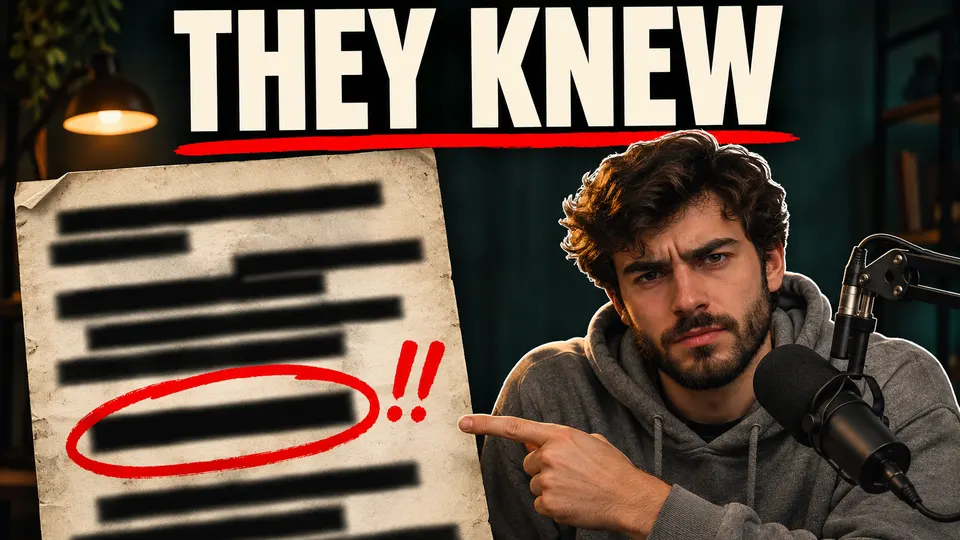
Made-up example, not a real video. They Knew the Whole Time
A dim room lit by one lamp. A host in a grey hoodie with a podcast microphone frowns and points at a sheet of paper where every line is blacked out, and one blacked-out line is circled in red with two exclamation marks. THEY KNEW is at the top with a red underline. The redacted page shows a secret without showing anything, which is useful when the evidence is a story rather than a picture.
Do the example titles fit?
We wrapped each example title into YouTube's title boxes with the same code our Title Checker uses. The box sizes were measured on youtube.com in November 2026, and this table was computed on 2026-11-17. All three are shown in full on every surface we measure. Short titles are the norm in the examples for a reason: the thumbnail carries the hook, so the title can stay brief.
| Title | Characters | Home feed, laptop | Home feed, large monitor | Search results, laptop | Up next sidebar, laptop | Phone feed, 390px wide |
|---|---|---|---|---|---|---|
| What Happened to Every Shopping Mall? | 37 | Shown in full | Shown in full | Shown in full | Shown in full | Shown in full |
| The Downfall of a Billion-Dollar Theme Park | 43 | Shown in full | Shown in full | Shown in full | Shown in full | Shown in full |
| They Knew the Whole Time | 24 | Shown in full | Shown in full | Shown in full | Shown in full | Shown in full |
The narrowest box is the up next sidebar on a laptop: 129 pixels wide, three lines. The full method and numbers are in our guide to where YouTube cuts off titles.
When to break the pattern
- When the story ends well (a comeback, a rescue, a fix), a dark and decaying frame misleads. Keep the red marks and the judging face, but let the colour warm up.
- Faceless channels can drop the host and let the scene and one red mark carry the whole frame. The mark then has to be larger.
- If your phrase repeats the title, try the thing the title leaves out instead: a year, a number, or the name of who knew.
Check your own thumbnail
- Shrink it to sidebar size. Is the red mark still the first thing you see?
- Is red the only strong colour, or is something else competing with it?
- Does the host's expression match the attitude of the video?
- Read the phrase and the title together. Does the phrase open a question that the title helps answer?
See yours next to these three
The Thumbnail Preview opens with the commentary and video essay examples already in place. Add your thumbnail and title to see them in the home feed, search, up next and on a phone. Nothing is uploaded.